How Claude's text watermark works
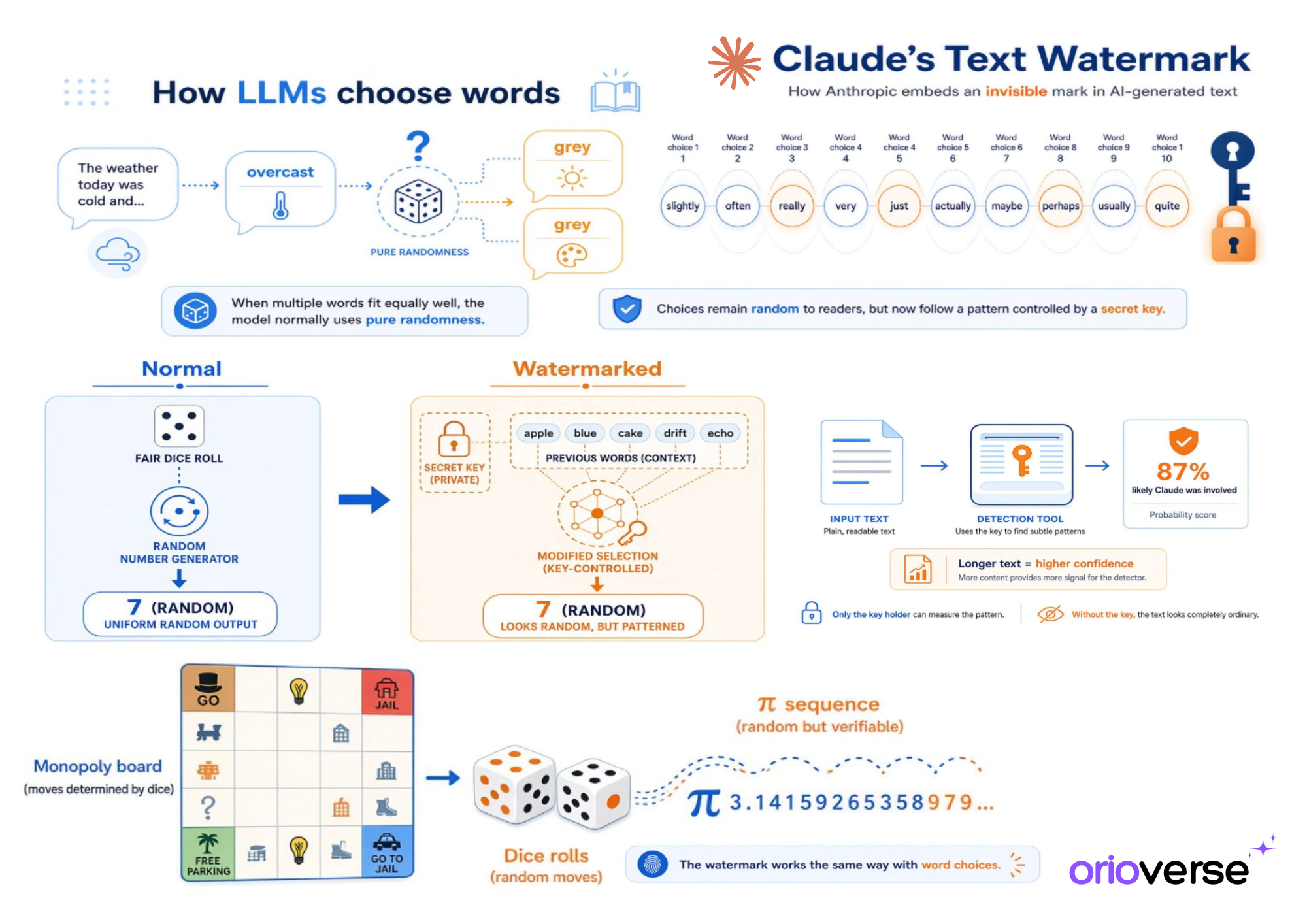
Anthropic just announced they have rolled out an invisible text watermark for Claude. Rather than changing the meaning of the text, they subtly guide Claude's word choices to create a statistically detectable pattern that can only be verified using their secret key.
How it works
Claude generates text one word at a time, and many of those choices are interchangeable. After "The weather today was cold and...", the next word is likely to be "overcast" or "grey" - both are fine, and the meaning barely changes either way. In cases like this, the choice is normally settled by a random number. The watermark changes the source of that randomness: instead of a generic random generator, the model uses the secret key and the preceding words to settle the choice. The output reads identically, but anyone holding the key can check whether the sequence of words is consistent with Claude's watermark-encoded randomness - and assign a probability that the text was written by Claude.
What it does not do
Anthropic is specific about the limits of the watermark:
- It has no practical impact on the quality or content of Claude's outputs. To a reader, a watermarked response is indistinguishable from an unwatermarked one.
- Nothing is added to the text. There are no hidden characters and no extra tokens, and it will not be more expensive.
- It carries no identifying information. It cannot be traced to a specific person, organization, or chat.
- It does not prove text was human-written. A watermark can only answer "what is the likelihood this was partly written by Claude?"
- It is sparser on factual passages, proofreading, and exact code - places where there is little freedom in word choice. Detection also needs a long enough sample.
Why now
This change is driven by the EU AI Act. As of August 2, the EU requires AI providers serving its market to mark AI-generated content. Anthropic signed the EU Code of Practice on Transparency of AI-Generated Content in July 2026 - one of around 190 signatories - and is applying watermarking globally at launch because there is not yet a durable way to scope it by region. Other major model developers have signed the same Code of Practice and are implementing their own watermarks.
The method is a version of the SynthID-Text approach published by Google DeepMind in a 2024 Nature paper, part of a family of techniques that goes back to Scott Aaronson's 2022 proposal.
What comes next
Anthropic will soon offer a watermark detection API so developers can check whether text was likely written by Claude. For supported files like images and SVGs, Claude will attach a C2PA content credential - a small cryptographically signed note in the file's metadata that records that the file was made or processed with Claude, separate from the text watermark.
Older Claude models launched before August 2, 2026 are in a transition period under the EU law, and Anthropic is working to add watermarking to them over the coming months.